
Part 1: What Could We Build Next?
Rethinking Homeschool Enrichment

Colorado’s homeschool landscape is changing
Programs are restructuring. Funding models are shifting. Some programs are moving under school districts. Others are exploring private-school structures or entirely new ways of operating. Families, educators, and homeschool leaders across our state are asking important questions about what comes next.
Those questions matter. But perhaps this moment also gives us an opportunity to ask a bigger question: What could we build next that might actually be better?
Not necessarily bigger. Not more complicated. And not simply a privately funded version of the same systems we’ve already built.
What if we went back to some of the strengths that have always made homeschooling work remarkably well? Parents. Relationships. Community. Shared resources. Individual gifts. Local leadership. Flexibility.
What if communities could create excellent homeschool enrichment programs that were privately funded, parent-powered, professionally supported, affordable, and sustainable? We think that possibility is worth exploring.
THE BIG IDEA
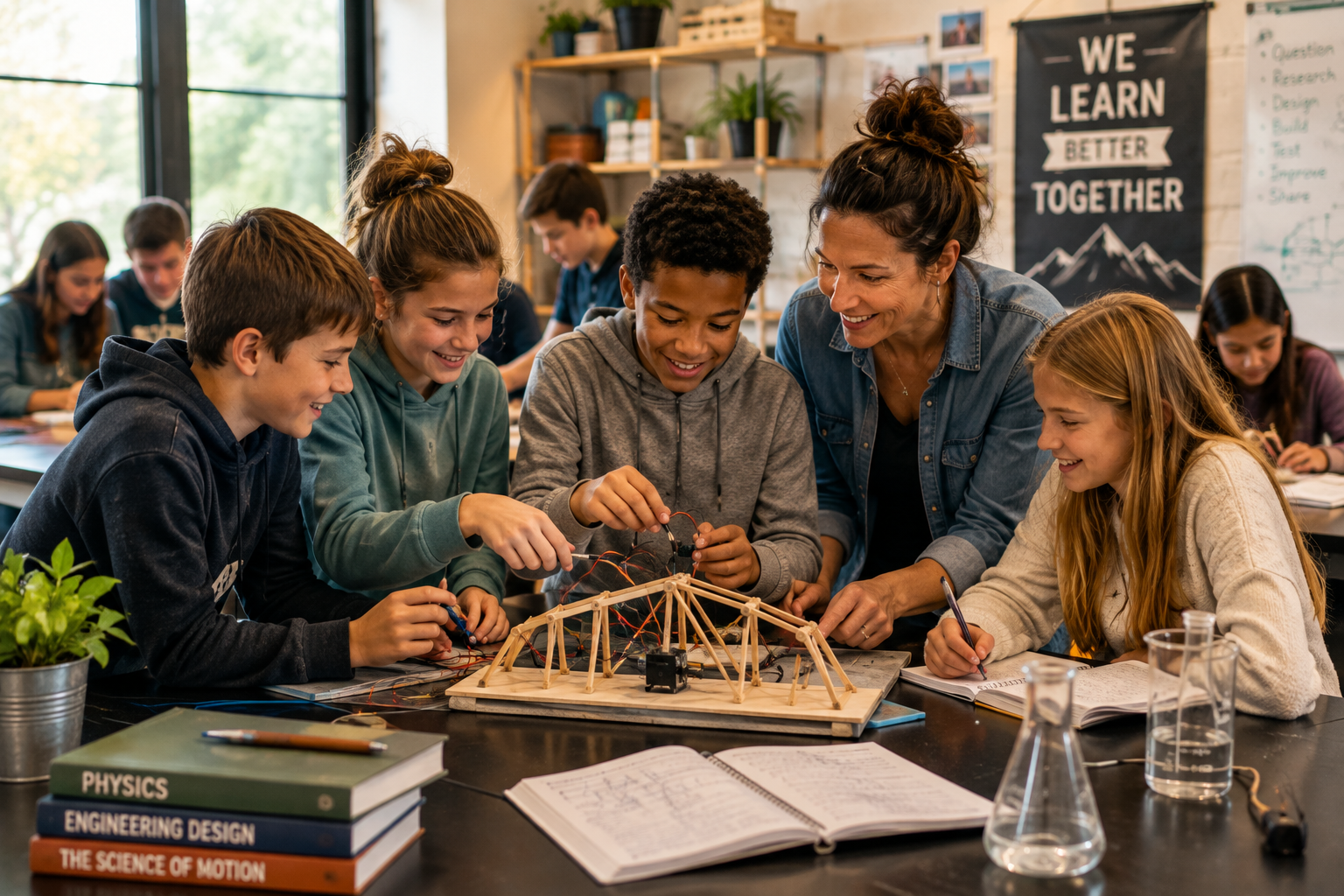
What if we only did together what is better together?
Imagine a one- or two-day-a-week homeschool learning community where parents remain responsible for their children’s education while students come together for the things that are significantly better experienced in community.
Science labs
Socratic discussions
Hands-on projects
Presentations and public speaking
STEM and engineering
Art and music
Entrepreneurship
Electives and practical skills
Physical education
Clubs and student leadership
Friendships and mentorship
Instead of trying to replicate five days of school in one or two days, the program concentrates its resources on the highest-value experiences to do together.
The question behind every part of the program becomes: Is this significantly better because we’re doing it together?
If the answer is yes, let's create an exceptional opportunity to do it together.
If a student can effectively complete it independently at home, perhaps that's exactly where it belongs.
Do together what is better together. Do at home what is better individualized.
That simple distinction could dramatically reduce the cost and complexity of operating an excellent homeschool enrichment program.
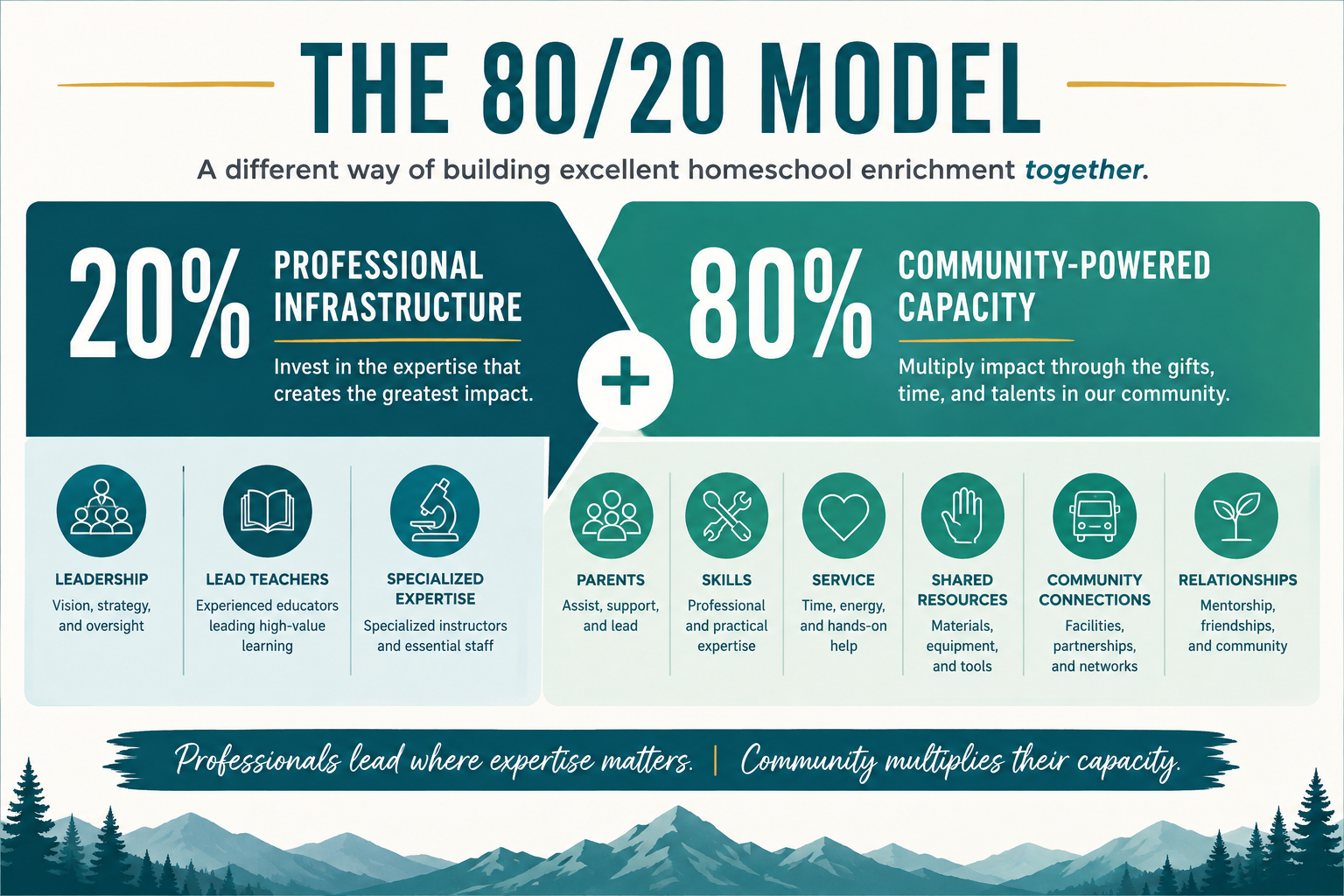
THE 80/20 MODEL
What if we stopped assuming a quality educational program requires a traditional school staffing model? Instead, imagine an operating philosophy built roughly around:
20% Professional Infrastructure
80% Community-Powered Capacity
This isn’t intended to be a literal staffing formula. It’s a different way of thinking about how we use our resources.
Rather than paying employees to perform every function required to operate a program, we identify the places where professional expertise creates the greatest value—and invest there.
That might include:
strong program leadership
experienced lead teachers
specialized instructors
essential administrative and operational support
Then parents and community members provide much of the capacity surrounding those professionals. Parents:
assist classrooms
supervise lunch and recreation
prepare materials
coordinate events and field trips
lead clubs
help with setup and cleanup
support check-in and dismissal
mentor students
contribute professional expertise
help build community
The goal isn’t to eliminate professionals. It’s to use professional expertise where it matters most while allowing the community to provide many of the functions we would otherwise have to pay someone to perform.
THE COMMUNITY BECOMES THE RESOURCE
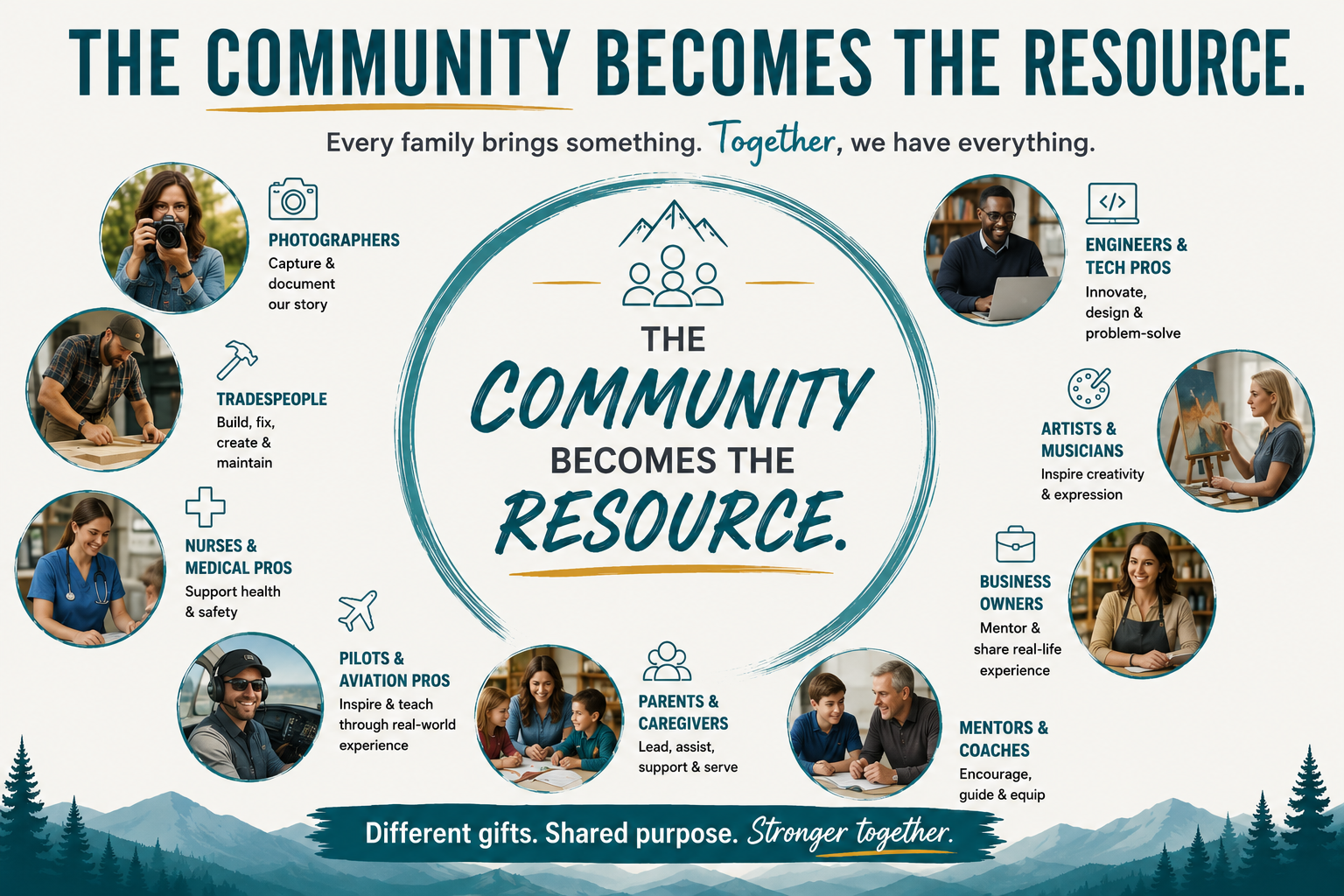
Every homeschool community already contains an extraordinary amount of talent. Think about the parents already sitting around our kitchen tables, at park days, in co-ops, at sporting events, and in homeschool groups across Colorado.
There are: Engineers. Nurses. Accountants. Pilots. Artists. Business owners. Carpenters. Musicians. Photographers. Software developers. Former teachers. Scientists. Tradespeople. First responders. Event planners. Military members. Stay-at-home moms and dads. College students. Retirees.
What if we stopped viewing those families only as consumers of a program? What if enrollment didn’t simply ask: “What does your child need from this community?” What if we also asked: “What could your family contribute to this community?”
An engineer might help with a STEM lab
A CPA might help with bookkeeping
A pilot might lead an aviation workshop
A photographer might handle program photography
A nurse or EMT might support health and safety
A business owner might mentor an entrepreneurship project
A musician might lead an elective
A carpenter might help with facility projects
A former teacher might lead or assist a class
And another parent might simply say: “Put me wherever you need me. I can supervise lunch.”
All of those contributions matter. Because when dozens of families each contribute a little, the community suddenly has access to an extraordinary amount of human capital. The community becomes the resource.
EVERY FAMILY HELPS BUILD IT
Volunteer-driven organizations often encounter the same problem. A relatively small number of people eventually carry most of the work.
What if we designed against that from the beginning? Participating families could agree to contribute approximately the same amount of service each year, regardless of what particular role they perform.
A one-day program might require a few hours each month. A two-day program might require more.
Families could choose from a variety of roles based on their schedules, interests, abilities, and professional skills. Some might serve during program hours. Others could contribute behind the scenes. Some could fill recurring positions. Others could complete projects.
And communities could explore alternatives for families whose circumstances prevent them from fulfilling the service commitment, such as a community-support fee that helps cover replacement staffing.
The exact system could look different in every community. The principle is what matters: We don’t simply consume community. We help build it.

PROFESSIONALS LEAD. PARENTS MULTIPLY THEIR CAPACITY
Parent-powered should never mean sacrificing quality. There are areas where experienced educators and specialized professionals provide tremendous value. Use them there. Pay excellent people to do high-value work.
Then surround them with a community that multiplies what they can accomplish. Imagine:
One excellent science instructor designing and leading a lab while parent assistants help students conduct experiments
One experienced writing instructor teaching concepts and leading discussion while parents facilitate small-group workshops
One STEM professional designing an engineering challenge while parent volunteers manage materials and student teams
One talented art instructor teaching technique while parents help manage supplies and workspaces
Instead of asking: “How many employees do we need to operate this program?” We begin asking: “Where does paid professional expertise create the greatest impact?”
Then we build the rest creatively around it.
THINK IN COMMUNITIES, NOT THIRTEEN GRADE LEVELS
Homeschooling doesn’t have to recreate a conventional school structure. Instead of operating separate programs for every grade, a collaborative might use broader age cohorts such as:
K–2nd
3rd–5th
6th–8th
9th–12th
Some electives and community experiences might span even larger age ranges. This reduces unnecessary staffing complexity while preserving developmentally appropriate learning. And it restores something homeschool communities often do particularly well: multi-age relationships.
Older students mentor younger students. Younger students see what comes next. Siblings share a community. Families know one another.
Learning becomes connected to relationships rather than artificially separated into thirteen completely different worlds.
USE THE BUILDINGS WE ALREADY HAVE
We may not need more educational buildings. Across Colorado, churches and community organizations have classrooms, fellowship halls, kitchens, gyms, parking lots, outdoor spaces, tables, chairs, Wi-Fi, and AV equipment sitting largely unused during weekdays.
What if homeschool communities partnered with them? A church or organization receives predictable facility income or an opportunity to support families in its community. The homeschool collaborative gains access to existing infrastructure without assuming the enormous expense of purchasing or operating its own campus.
Use what already exists. That’s another piece of the 80/20 philosophy.
AFFORDABLE DOESN’T HAVE TO MEAN FREE
Excellent programs cost money. Teachers deserve to be compensated. Facilities cost money. Insurance costs money. Curriculum and supplies cost money. Administration costs money.
The goal isn’t necessarily to make everything free. The goal is to ask: How affordable could excellent homeschool enrichment become if we intentionally removed unnecessary overhead and everyone contributed something?
A sustainable collaborative could primarily operate through:
Family Tuition
Community Contribution
Lean Operations
Then scholarships, charitable giving, church partnerships, business sponsorships, and fundraising could help families who otherwise couldn’t participate.
That creates an important distinction: Tuition sustains the program. Generosity expands access. The goal is a program capable of sustaining itself without depending upon a single outside funding source for its continued existence.
HOW COULD WE FUND THIS PRIVATELY?
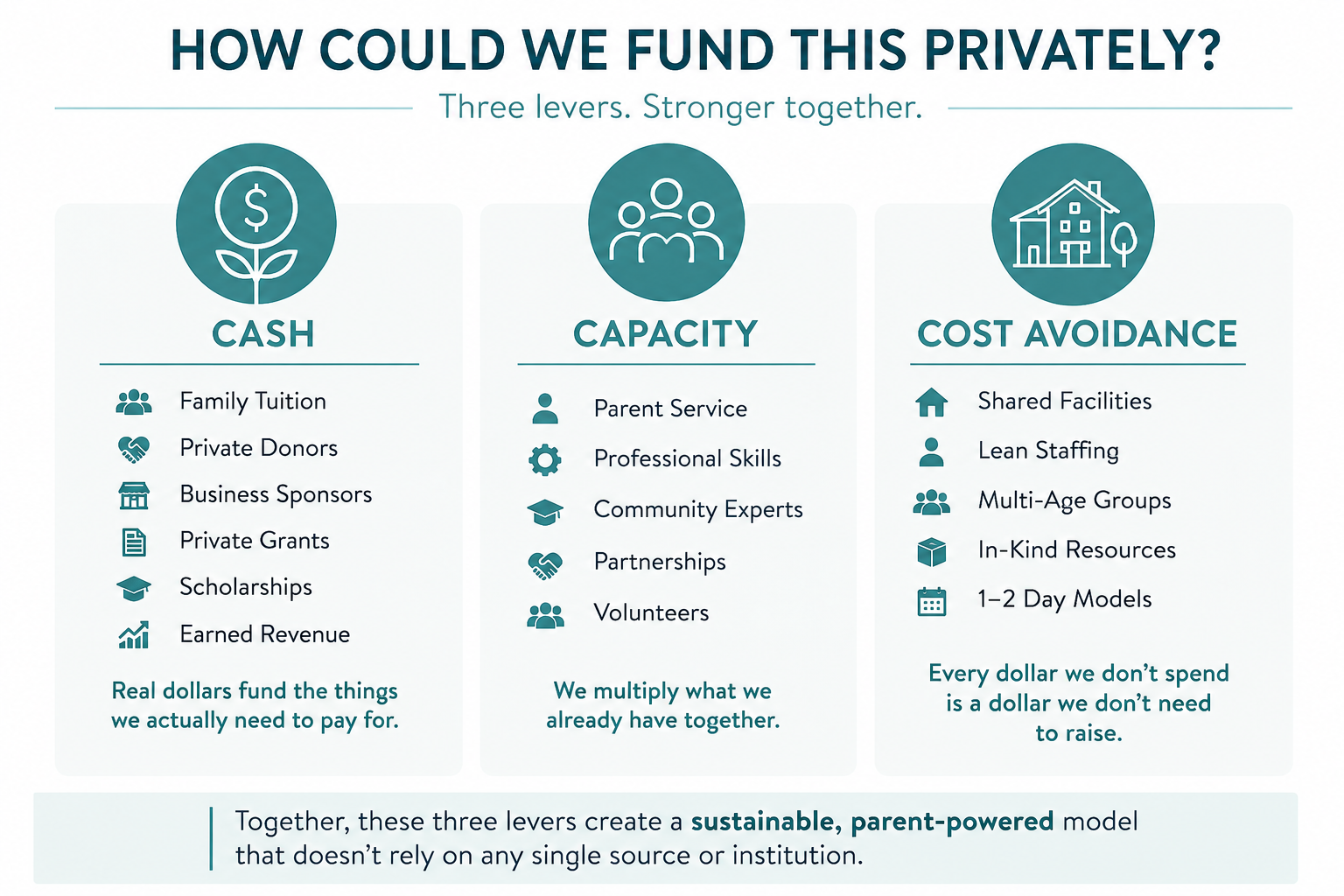
Privately funded doesn’t necessarily mean families have to pay for everything themselves. Instead of asking how to replace one large source of government funding with one large source of private funding, what if we approached sustainability through three different levers?
Cash — Tuition • Private Donors • Business Sponsors • Private Grants • Scholarships • Earned Revenue
Real dollars fund the things we actually need to pay for: instructors, facilities, insurance, materials, administration, and other essential expenses
Capacity — Parent Service • Professional Skills • Community Experts • Partnerships
Every time someone contributes time, expertise, services, equipment, or connections that we would otherwise have to purchase, the economics change
Cost Avoidance — Shared Facilities • Lean Staffing • Multi-Age Groups • In-Kind Resources • 1–2 Day Models
Sometimes the most effective funding strategy is simply not creating an expense we don’t need
Every dollar we don’t need to spend is a dollar we don’t need to raise. Perhaps the question isn’t simply: “How do we replace government funding?” But instead: “How do we build a model that doesn’t require it?”
Cash + Capacity + Cost Avoidance could allow communities to build something financially sustainable without expecting family tuition alone to carry the entire load.
In Part 2: The Blueprint, we’ll dig into the numbers — including tuition models, private funding strategies, parent service, staffing costs, facilities, sponsorships, scholarships, and break-even scenarios.
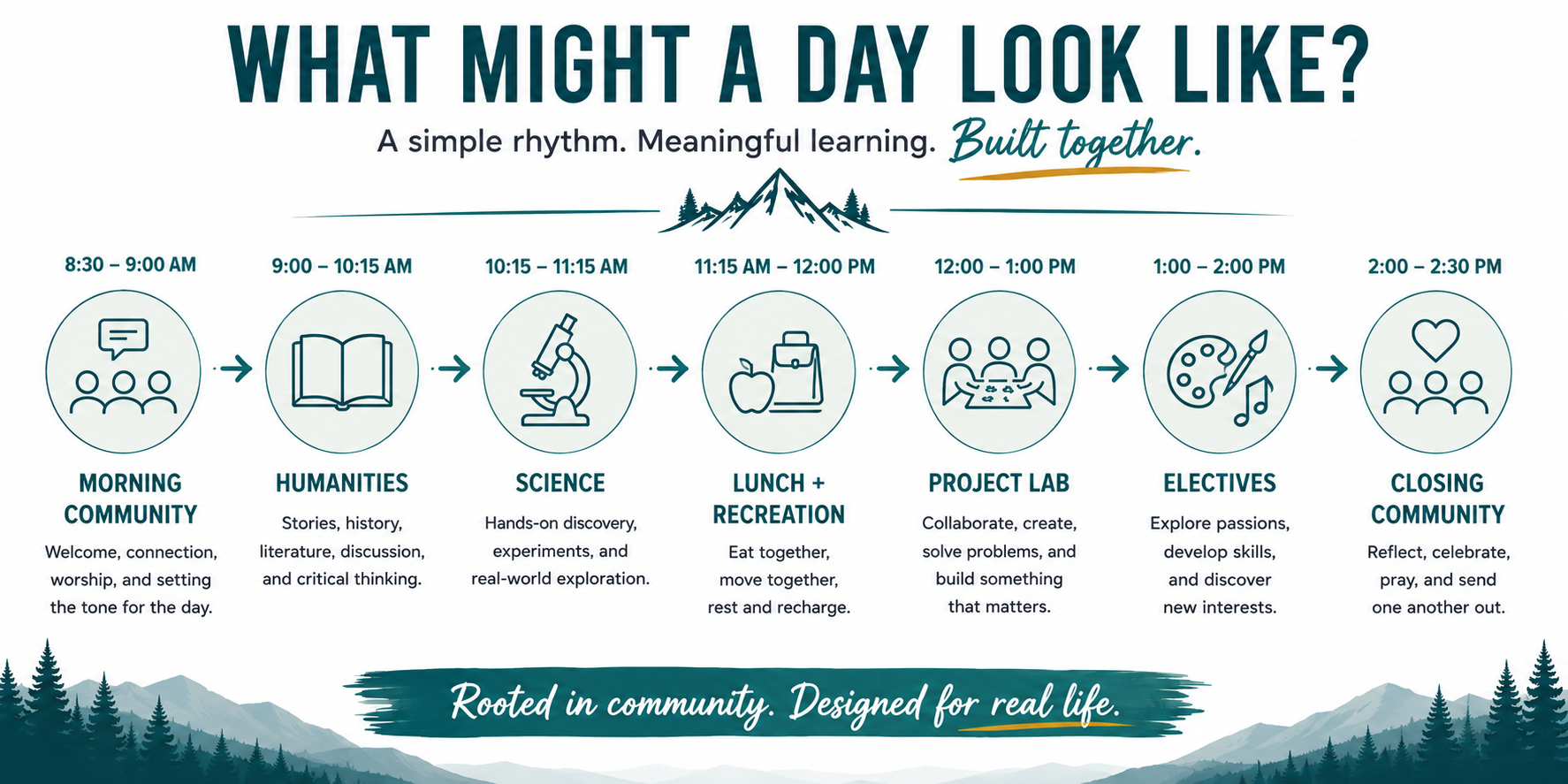
WHAT MIGHT A DAY LOOK LIKE?
A collaborative day doesn’t need to be packed with traditional academic classes. Instead, build the schedule around experiences that become more valuable because students are together.
Morning Community — Welcome, announcements, community building, worship or gathering depending upon the organization’s mission
Humanities — Literature discussion, history, Socratic seminar, communication, debate, writing workshops, presentations
Science — Experiments, demonstrations, labs, collaborative investigation
Lunch + Recreation — Relationships, outdoor time, movement, games
Project Lab — Engineering, entrepreneurship, robotics, maker projects, design, practical skills
Electives — Art, music, photography, personal finance, aviation, trades, technology, leadership, or expertise unique to the local community
Closing Community — Student presentations, reflection, celebration, announcements
Then students return home for the individualized learning that homeschooling does particularly well.
START SMALLER THAN YOU THINK
Perhaps one of the most important principles is this: Don’t begin by trying to replace everything. Start with the 20% that creates 80% of the value. Imagine beginning with:
1 Day Each Week
30-50 Families
4 Age Cohorts
4–5 High-Value Learning Blocks
A Few Excellent Lead Instructors
1 Affordable Shared Facility
Clear family service commitment
That’s enough to build something meaningful.
Start. Learn. Adjust. Improve. Grow only when growth makes the community better.

WHAT IF 50 FAMILIES DID THIS?
Imagine 50 families deciding: We’re going to build this together. Every family contributes financially. Every family contributes some amount of time.
A handful of excellent educators provide professional leadership. Parents collectively contribute thousands of hours of capacity.
A local church or organization provides affordable space. Community professionals share their expertise.
Students receive meaningful classes, labs, projects, friendships, mentorship, and experiences. Families retain responsibility for the rest of their homeschool.
No single parent has to create everything. No organization has to hire someone for every function. No one funding source determines whether the community can continue existing.
At that point, this begins looking less like a program families simply attend and more like a: community-powered educational ecosystem.
NOW IMAGINE IT ACROSS COLORADO
This may be the most exciting part. The vision isn’t necessarily for one organization to open dozens of campuses.
It isn’t one centralized curriculum. It isn’t another large educational institution.
Imagine instead: Local communities building local solutions.
A group in Pueblo builds one. Families in Castle Rock build another. Someone in Grand Junction adapts the model. A rural church or community organization opens its building to twenty families. Parents in Northern Colorado create a STEM-focused version. A Christian community integrates discipleship, worship, and biblical worldview throughout its program. Another community develops something completely different around the needs of its families.
Each one is locally led. Each one uses the gifts already present in its community. Each one adapts the model to its own mission.
And then those communities begin sharing what works: budgets, schedules, policies, volunteer systems, job descriptions, facility agreements, curriculum recommendations, lessons learned, etc.
Instead of hundreds of homeschool leaders independently reinventing the wheel, we begin creating a shared ecosystem of community-built solutions.

MAYBE THE GOAL ISN’T TO REBUILD WHAT WE HAD
Change is difficult, particularly when families have found teachers, programs, and communities they love. There are valuable publicly funded enrichment programs, private programs, independent schools, co-ops, hybrid programs, learning centers, and completely independent homeschool families across Colorado.
Families should have room to choose among them. This isn’t an argument against those options. It’s an invitation to imagine another one.
When a landscape changes, our first instinct is understandably to ask: How do we preserve what we had?
But perhaps another question belongs beside it: What could we build next that might actually be better? More local. More resilient. More affordable. More relational. More flexible. More parent-powered.
Less dependent upon any single institution or funding source.
Built around the strengths of homeschooling rather than simply recreating the structures of conventional school.
Maybe some communities will explore this idea and decide it isn’t right for them. Maybe others will borrow one piece and create something completely different.
And maybe somewhere in Colorado, twenty parents will read this and say: “We could actually do this.”
That’s the point.
THIS IDEA IS MEANT TO BE SHARED
This isn’t a True North program model that communities need permission to use. It’s an idea we’re putting into the Colorado homeschool community because we believe good ideas should multiply.
Take it. Adapt it. Improve it. Build something that works for your families and your community.
Share what you learn with others. Because the goal isn’t for one organization to become the solution. The goal is to help homeschool families recognize something that has been true all along …
Together, our communities already possess many of the resources we need to build remarkable things.
COMING NEXT — THE BLUEPRINT
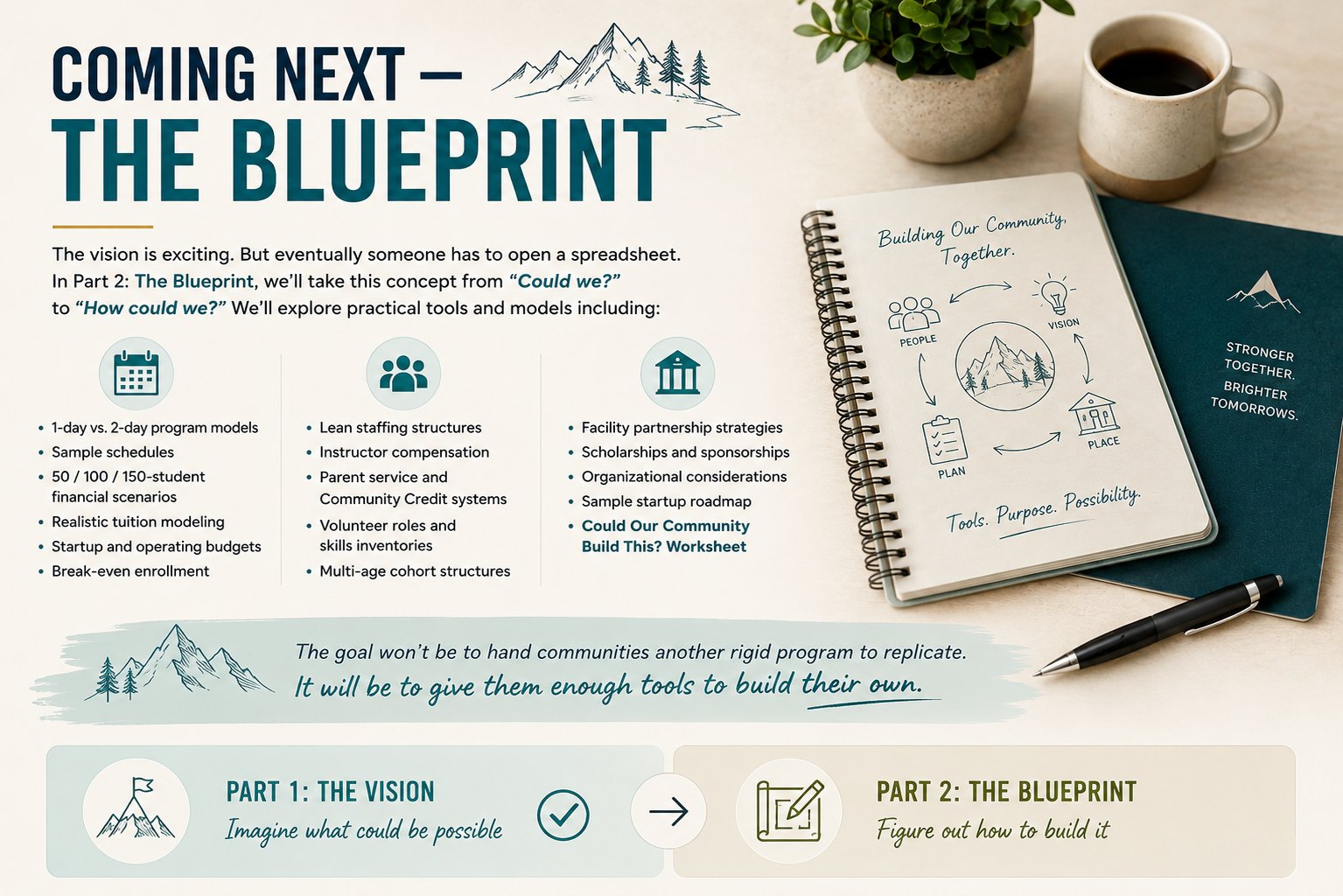
The vision is exciting. But eventually someone has to open a spreadsheet. In Part 2: The Blueprint, we’ll take this concept from “Could we?” to “How could we?” We’ll explore practical tools and models including:
1-day vs. 2-day program models
Sample schedules
50 / 100 / 150-student financial scenarios
Realistic tuition modeling
Startup and operating budgets
Break-even enrollment
Lean staffing structures
Instructor compensation
Parent service and Community Credit systems
Volunteer roles and skills inventories
Multi-age cohort structures
Facility partnership strategies
Scholarships and sponsorships
Organizational considerations
Sample startup roadmap
Could Our Community Build This? Worksheet
The goal won’t be to hand communities another rigid program to replicate. It will be to give them enough tools to build their own.
PART 1: THE VISION — Imagine what could be possible
PART 2: THE BLUEPRINT — Figure out how to build it
A NOTE BEFORE YOU BUILD
This resource is intended to spark ideas and provide a framework for exploration. It is not legal, tax, employment, insurance, educational, or regulatory advice. The legal and operational requirements for a homeschool co-op, private enrichment provider, nonprofit organization, church ministry, private school, or other educational organization can differ significantly. Any community exploring a model like this should obtain appropriate guidance regarding organizational structure, insurance, child safety, background checks, employment and volunteer practices, facility use, taxes, and applicable Colorado law before launching.
Build creatively. Build responsibly. And build something that serves your community well.
Want to Start Smaller?
Not every community needs a structured 1–2 day enrichment program. Sometimes a simple parent-led co-op is exactly the right place to begin. If that’s what your community needs, explore our free Start a Homeschool Co-op in 15 Days Guide —>