Part 2: The Blueprint
Figure Our How to Build It

The vision is exciting. But eventually someone has to open a spreadsheet.
In Part 1, we asked a different question about the changing homeschool landscape: What could we build next that might actually be better?
More local. More resilient. More affordable. More relational. More flexible. More parent-powered.
Now it’s time to ask the practical question: Could we actually build it?
This Blueprint is designed to help homeschool parents and community leaders explore that question for themselves.
Not by handing communities another packaged program to replicate. Not by assuming every community needs the same thing. And not by pretending there is one perfect model.
Instead, we’ll take the ideas from Part 1 and begin putting structure, schedules, staffing, facilities, funding—and eventually real numbers — behind them.
The goal is simple: Give communities enough tools to determine what they could realistically build with the people, resources, spaces, and opportunities already around them.

BEFORE YOU BUILD A BUDGET, BUILD THE MODEL
One of the easiest mistakes would be to begin with: “How much money can we raise?” or “What should tuition be?” Those questions matter.
But they aren’t the first questions. Before determining what something should cost, determine what you’re actually trying to build.
A community might want:
1 Day Program — A high-impact enrichment day per week centered around the experiences that are better together
2 Day Program — A more robust hybrid-style collaborative per week with additional academic, project-based, and elective opportunities
30–50 STUDENTS — A small pilot where everyone knows everyone and the operating model stays extremely lean
100+ STUDENTS — A larger collaborative capable of supporting more instructors, cohorts, electives, and specialized programming
Those are very different programs. And they require very different budgets.
So start here: What do families actually need? Not: What kind of school can we recreate? That distinction matters.
DESIGN AROUND WHAT’S BETTER TOGETHER
A privately funded homeschool enrichment program doesn’t need to become a five-day school with fewer days. Home remains incredibly good at many things. Independent reading. Math practice. Writing assignments. Individualized instruction. Family discipleship. Self-paced curriculum. One-on-one support.
So don’t automatically pay a program to reproduce those things.
Instead, invest shared time and money where gathering creates disproportionate value:
Science labs
Hands-on projects
Socratic discussion
Presentations
Fine arts
STEM and engineering
Trades and practical skills
Entrepreneurship
Collaborative learning
Specialty instructors
Clubs and electives
Friendships and community
Spend shared resources on the things that are genuinely better together. That’s one of the simplest ways to make the entire model more affordable.
Start With the Smallest Version That Works
You don’t need 300 students, a building, twelve employees, and a giant catalog of classes to begin. You need enough.
A first-year model might be as simple as:
1 Day — per week
30–50 Students — or a manageable number of founding families
3–4 Multi-Age Cohorts — rather than separate classes for every grade
4–5 Great Learning Blocks — focused on experiences worth gathering for
A Few Strong Instructors — paid where expertise matters
Parent Capacity — built directly into the operating model
1 Shared Facility — that already exists
That’s enough to test an idea. And if it works? Then grow.
BUILD THE TEAM DIFFERENTLY
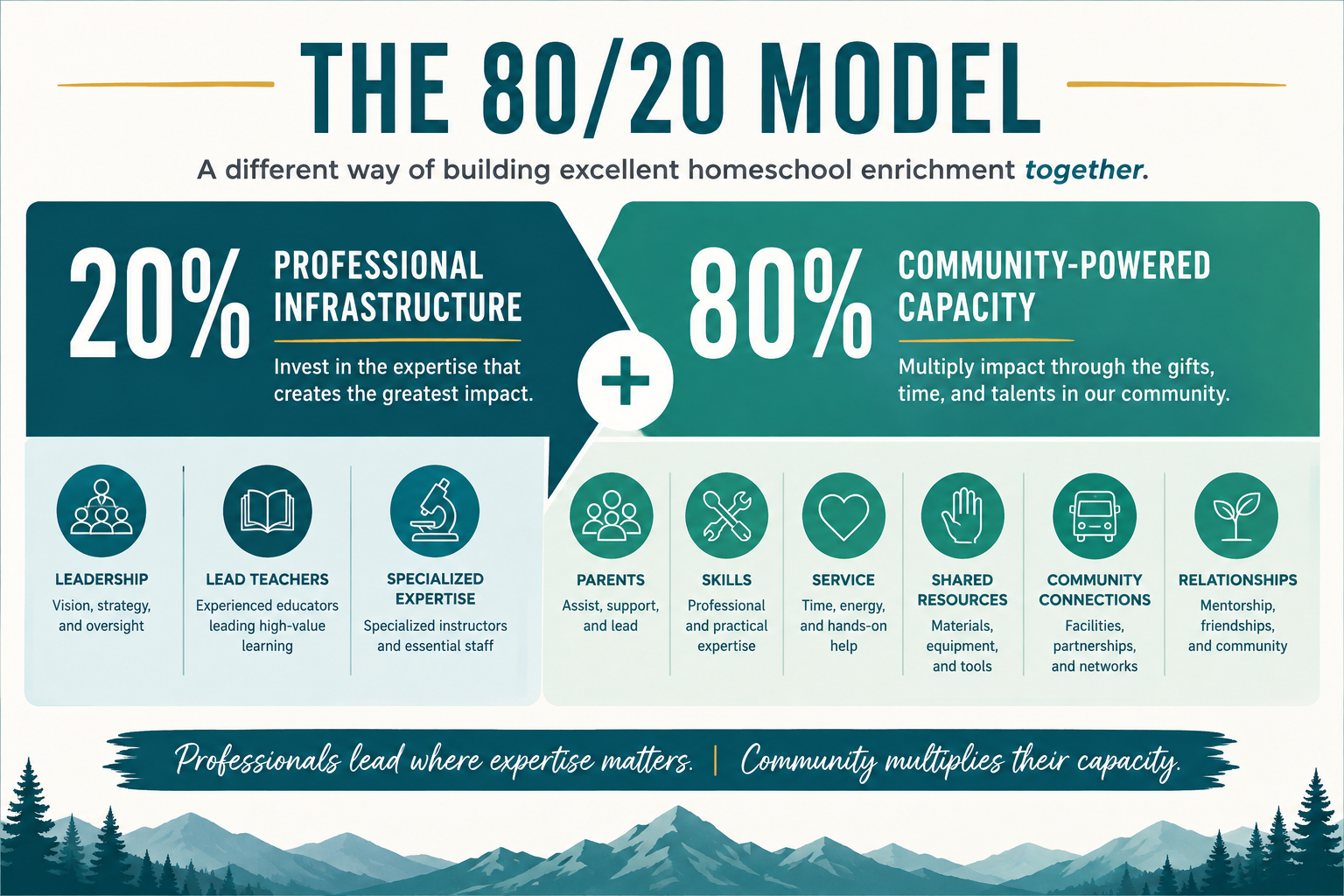
This is where the 80/20 philosophy from Part 1 becomes an actual operating model.
A conventional program might ask: How many employees do we need?
A community-powered program asks: Which roles truly require paid professional leadership — and which can be multiplied through the capacity of our families?
Professional Core: These are the people responsible for the areas where expertise, consistency, accountability, or continuity matter most. Depending upon the program, that might include:
Program Director — Provides overall leadership, operations, family communication, safety, systems, and program quality
Lead Instructors — Strong teachers or subject-matter experts responsible for core learning experiences
Specialty Instructors — Professionals brought in for science, art, music, engineering, trades, entrepreneurship, languages, or other specialized areas
Administrative Support — Depending on scale, bookkeeping, registration, compliance, scheduling, or other functions may warrant paid support
But professionals don’t have to carry the entire program.

THEN MULTIPLY THEM WITH PARENTS
Imagine a skilled science instructor teaching a lab. Instead of hiring three additional employees, several parents help manage supplies, assist student teams, photograph projects, supervise transitions, and clean the room afterward.
The instructor gets to focus on the thing you’re actually paying them to do exceptionally well: Teach.
Parents might contribute through: Classroom assistance • setup and cleanup • lunch and recreation • field trips • clubs • events • technology • photography • communications • hospitality • supply management • student showcases • facility support • administrative projects.
And some families will bring considerably more specialized capacity. Which leads to one of the first practical tools every community should use.
BUILD A COMMUNITY SKILLS + RESOURCES INVENTORY
Before hiring. Before purchasing. Before fundraising. Find out what you already have.
Ask every participating family:
What do you know?
What can you do?
What could you teach?
What equipment or resources do you have access to?
What organizations or businesses are you connected to?
What would you actually enjoy contributing?
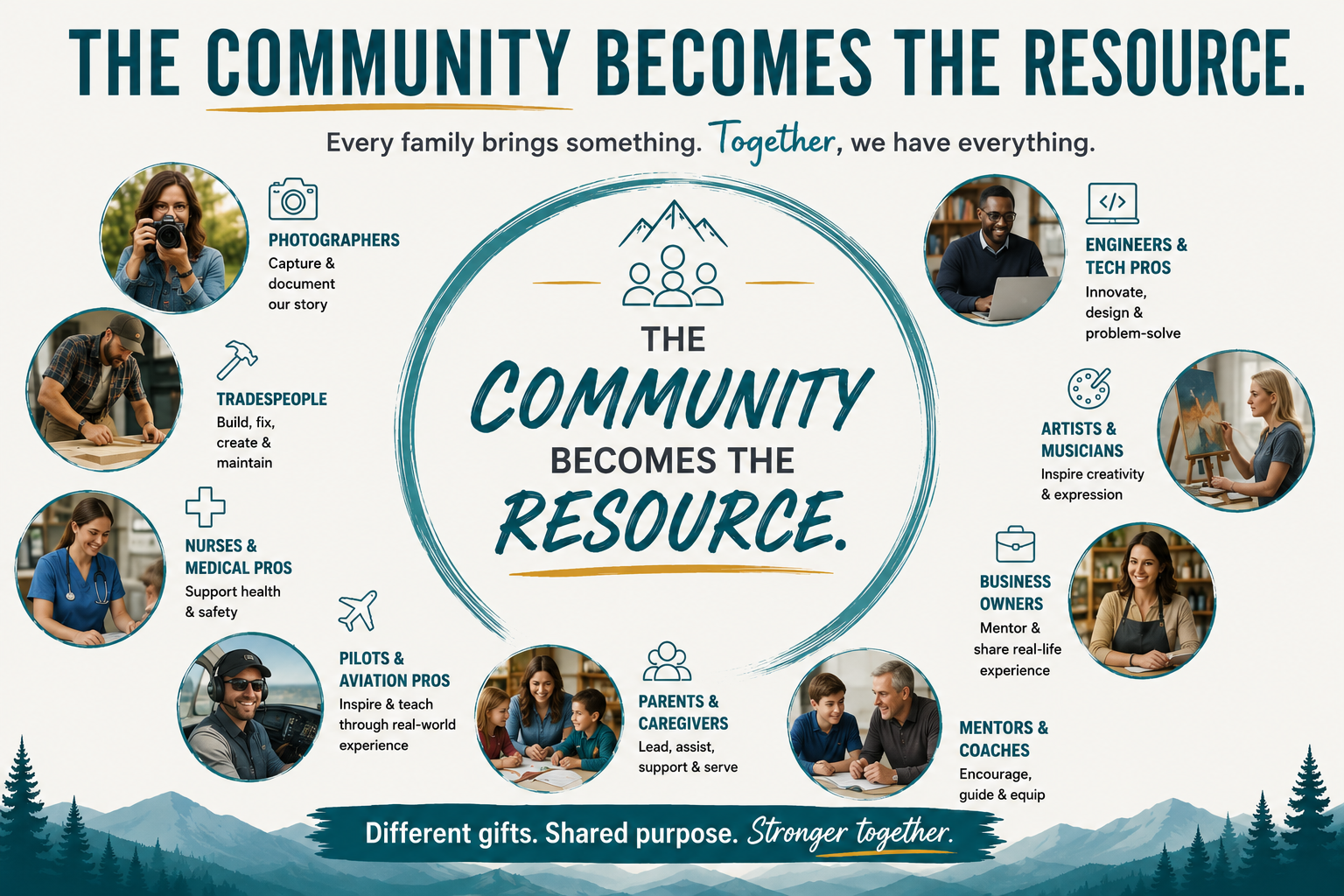
You may discover a: CPA, licensed teacher, engineer, nurse, pilot, contractor, graphic designer, photographer, musician, software developer, business owner, farmer, retired professor, etc. Maybe even someone whose church has twenty empty classrooms every Tuesday.
That’s capacity. It just doesn’t appear on a bank statement.
EVERY FAMILY CONTRIBUTES
This is one place where I would make the model intentionally different from many optional-volunteer programs. If community participation is what makes the economics work, it can’t depend upon the same ten parents doing everything.
Instead, establish a Community Service Commitment for participating families. For example: Every family contributes the same baseline number of service hours per month or semester. Families could then select roles according to their skills, interests, schedules, and program needs.
A family with an accountant might contribute bookkeeping expertise. Another might serve weekly during lunch. Another could manage supplies. Another might assist an instructor. Another could coordinate a student showcase.
Equal contribution doesn’t have to mean identical contribution. The objective is shared ownership.
NOW WE CAN ASK THE MONEY QUESTION
Once you’ve decided:
What you’re building
Who you’re serving
What happens during the program day
Which professionals you actually need
What parents can contribute
What resources already exist
What facility you need
...then we can finally ask: What does this actually cost?
And that’s where the next part of the Blueprint gets especially practical. We’ll build the model using three levers:
Cash — Tuition • Private Giving • Sponsors • Grants • Earned Revenue
Capacity — Parents • Professionals • Community Experts • Partnerships
Cost Avoidance — Shared Facilities • Lean Staffing • Multi-Age Cohorts • In-Kind Resources
Then we’ll put actual numbers behind it.
50 students. 100 students. 150 students
One day. Two days.
Different tuition levels.
Different instructor compensation.
Different facility costs.
And we’ll find the point where the model actually works.
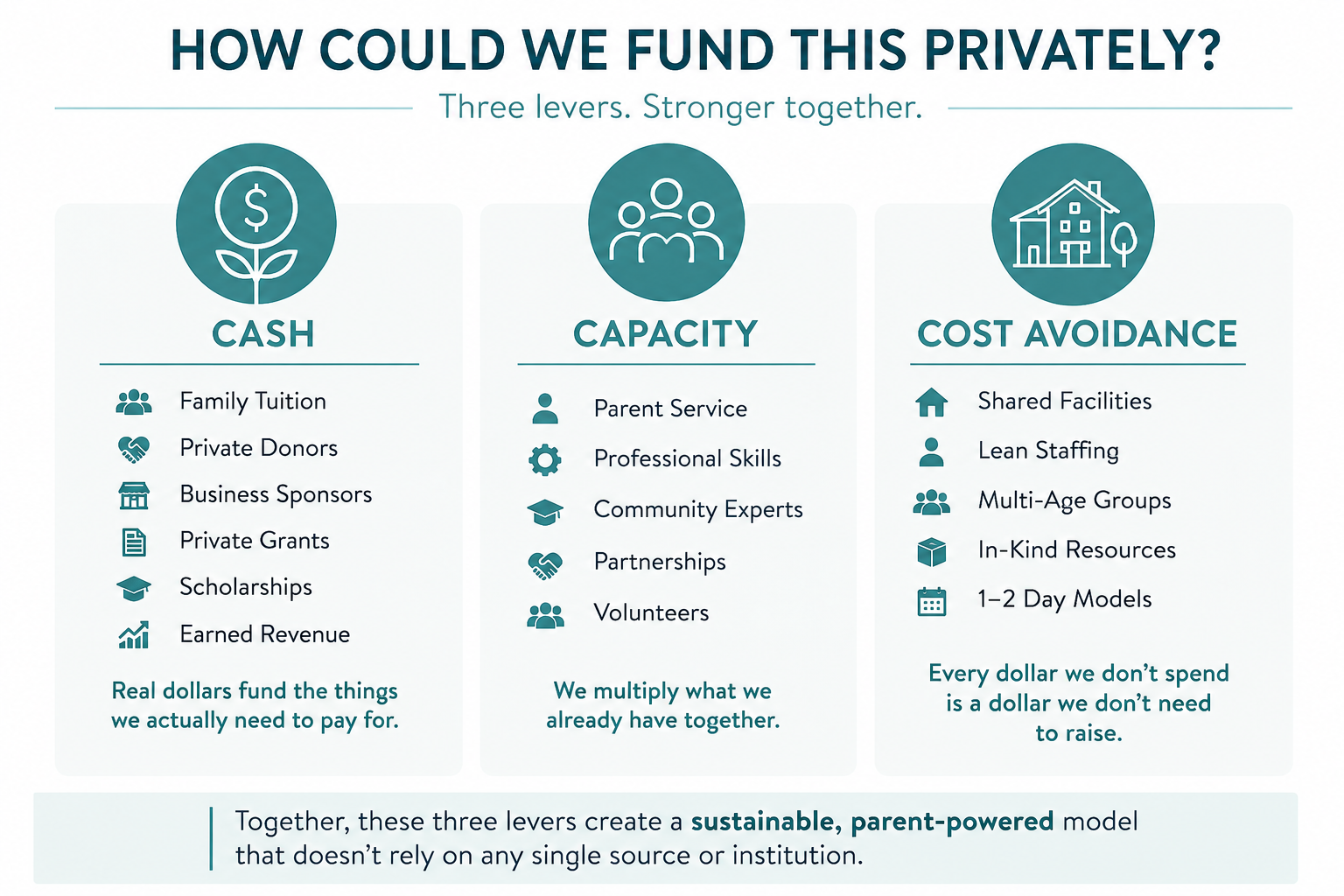
HOW COULD WE FUND THIS PRIVATELY?
Privately funded doesn’t necessarily mean families have to pay for everything themselves. Instead of asking how to replace one large source of government funding with one large source of private funding, what if we approached sustainability through three different levers?
Cash — Tuition • Private Donors • Business Sponsors • Private Grants • Scholarships • Earned Revenue
Real dollars fund the things we actually need to pay for: instructors, facilities, insurance, materials, administration, and other essential expenses
Capacity — Parent Service • Professional Skills • Community Experts • Partnerships
Every time someone contributes time, expertise, services, equipment, or connections that we would otherwise have to purchase, the economics change
Cost Avoidance — Shared Facilities • Lean Staffing • Multi-Age Groups • In-Kind Resources • 1–2 Day Models
Sometimes the most effective funding strategy is simply not creating an expense we don’t need
Every dollar we don’t need to spend is a dollar we don’t need to raise. Perhaps the question isn’t simply: “How do we replace government funding?” But instead: “How do we build a model that doesn’t require it?”
Cash + Capacity + Cost Avoidance could allow communities to build something financially sustainable without expecting family tuition alone to carry the entire load.
In Part 2: The Blueprint, we’ll dig into the numbers — including tuition models, private funding strategies, parent service, staffing costs, facilities, sponsorships, scholarships, and break-even scenarios.
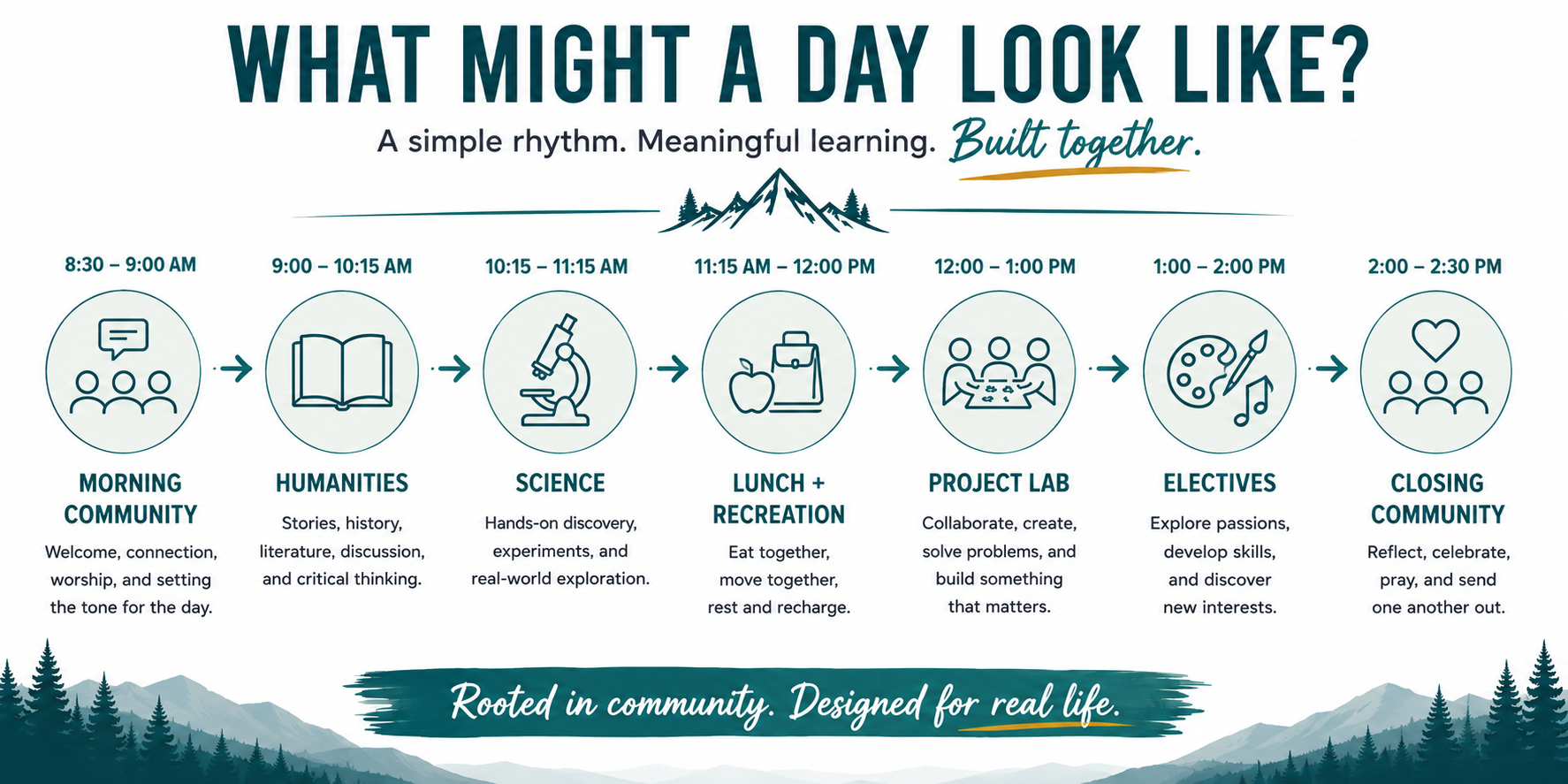
WHAT MIGHT A DAY LOOK LIKE?
A collaborative day doesn’t need to be packed with traditional academic classes. Instead, build the schedule around experiences that become more valuable because students are together.
Morning Community — Welcome, announcements, community building, worship or gathering depending upon the organization’s mission
Humanities — Literature discussion, history, Socratic seminar, communication, debate, writing workshops, presentations
Science — Experiments, demonstrations, labs, collaborative investigation
Lunch + Recreation — Relationships, outdoor time, movement, games
Project Lab — Engineering, entrepreneurship, robotics, maker projects, design, practical skills
Electives — Art, music, photography, personal finance, aviation, trades, technology, leadership, or expertise unique to the local community
Closing Community — Student presentations, reflection, celebration, announcements
Then students return home for the individualized learning that homeschooling does particularly well.
START SMALLER THAN YOU THINK
Perhaps one of the most important principles is this: Don’t begin by trying to replace everything. Start with the 20% that creates 80% of the value. Imagine beginning with:
1 Day Each Week
30-50 Families
4 Age Cohorts
4–5 High-Value Learning Blocks
Few Excellent Lead Instructors
1 Affordable Shared Facility
Clear family service commitment
That’s enough to build something meaningful.
Start. Learn. Adjust. Improve. Grow only when growth makes the community better.

WHAT IF 50 FAMILIES DID THIS?
Imagine 50 families deciding: We’re going to build this together. Every family contributes financially. Every family contributes some amount of time.
A handful of excellent educators provide professional leadership. Parents collectively contribute thousands of hours of capacity.
A local church or organization provides affordable space. Community professionals share their expertise.
Students receive meaningful classes, labs, projects, friendships, mentorship, and experiences. Families retain responsibility for the rest of their homeschool.
No single parent has to create everything. No organization has to hire someone for every function. No one funding source determines whether the community can continue existing.
At that point, this begins looking less like a program families simply attend and more like a: community-powered educational ecosystem.
NOW IMAGINE IT ACROSS COLORADO
This may be the most exciting part. The vision isn’t necessarily for one organization to open dozens of campuses.
It isn’t one centralized curriculum. It isn’t another large educational institution.
Imagine instead: Local communities building local solutions.
A group in Pueblo builds one. Families in Castle Rock build another. Someone in Grand Junction adapts the model. A rural church or community organization opens its building to twenty families. Parents in Northern Colorado create a STEM-focused version. A Christian community integrates discipleship, worship, and biblical worldview throughout its program. Another community develops something completely different around the needs of its families.
Each one is locally led. Each one uses the gifts already present in its community. Each one adapts the model to its own mission.
And then those communities begin sharing what works: budgets, schedules, policies, volunteer systems, job descriptions, facility agreements, curriculum recommendations, lessons learned, etc.
Instead of hundreds of homeschool leaders independently reinventing the wheel, we begin creating a shared ecosystem of community-built solutions.

MAYBE THE GOAL ISN’T TO REBUILD WHAT WE HAD
Change is difficult, particularly when families have found teachers, programs, and communities they love. There are valuable publicly funded enrichment programs, private programs, independent schools, co-ops, hybrid programs, learning centers, and completely independent homeschool families across Colorado.
Families should have room to choose among them. This isn’t an argument against those options. It’s an invitation to imagine another one.
When a landscape changes, our first instinct is understandably to ask: How do we preserve what we had?
But perhaps another question belongs beside it: What could we build next that might actually be better? More local. More resilient. More affordable. More relational. More flexible. More parent-powered.
Less dependent upon any single institution or funding source.
Built around the strengths of homeschooling rather than simply recreating the structures of conventional school.
Maybe some communities will explore this idea and decide it isn’t right for them. Maybe others will borrow one piece and create something completely different.
And maybe somewhere in Colorado, twenty parents will read this and say: “We could actually do this.”
That’s the point.
THIS IDEA IS MEANT TO BE SHARED
This isn’t a True North program model that communities need permission to use. It’s an idea we’re putting into the Colorado homeschool community because we believe good ideas should multiply.
Take it. Adapt it. Improve it. Build something that works for your families and your community.
Share what you learn with others. Because the goal isn’t for one organization to become the solution. The goal is to help homeschool families recognize something that has been true all along …
Together, our communities already possess many of the resources we need to build remarkable things.
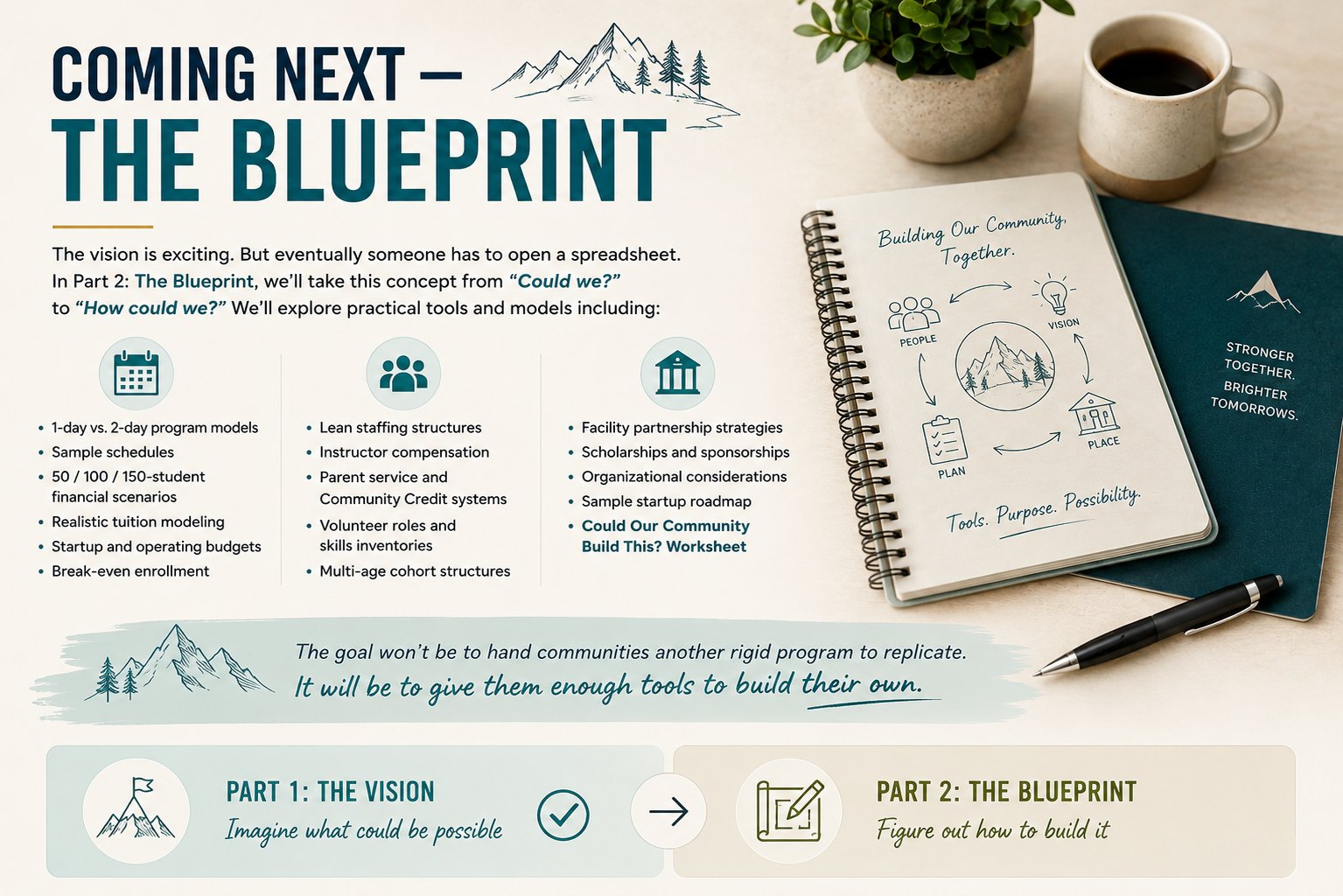
COMING NEXT — THE BLUEPRINT
The vision is exciting. But eventually someone has to open a spreadsheet. In Part 2: The Blueprint, we’ll take this concept from “Could we?” to “How could we?” We’ll explore practical tools and models including:
1-day vs. 2-day program models
Sample schedules
50 / 100 / 150-student financial scenarios
Realistic tuition modeling
Startup and operating budgets
Break-even enrollment
Lean staffing structures
Instructor compensation
Parent service and Community Credit systems
Volunteer roles and skills inventories
Multi-age cohort structures
Facility partnership strategies
Scholarships and sponsorships
Organizational considerations
Sample startup roadmap
Could Our Community Build This? Worksheet
The goal won’t be to hand communities another rigid program to replicate. It will be to give them enough tools to build their own.
PART 1: THE VISION — Imagine what could be possible
PART 2: THE BLUEPRINT — Figure out how to build it
A NOTE BEFORE YOU BUILD
This resource is intended to spark ideas and provide a framework for exploration. It is not legal, tax, employment, insurance, educational, or regulatory advice. The legal and operational requirements for a homeschool co-op, private enrichment provider, nonprofit organization, church ministry, private school, or other educational organization can differ significantly. Any community exploring a model like this should obtain appropriate guidance regarding organizational structure, insurance, child safety, background checks, employment and volunteer practices, facility use, taxes, and applicable Colorado law before launching.
Build creatively. Build responsibly. And build something that serves your community well.
Want to Start Smaller?
Not every community needs a structured 1–2 day enrichment program. Sometimes a simple parent-led co-op is exactly the right place to begin. If that’s what your community needs, explore our free Start a Homeschool Co-op in 15 Days Guide —>